AUTHOR: IVO MARTINS
EDITION: (Catalogue) Centro de Estudos de Jazz da UA - Universidade de Aveiro DATE: June 2025 - June 2026
Foreword
Susana Sardo
Director, Centre for Jazz Studies Scientific Curator, University of Aveiro Sound Archives
The Centre for Jazz Studies was officially established on 14 August 2007, following the transfer of the collection of jazz broadcaster José Duarte to the University of Aveiro. To this collection – with its hundreds of recordings, books, and manuscripts from radio and television programmes devoted to jazz – were later added Carlos Martins’s vinyl record collection (2009), Alan Spennock’s shellac record collection (2015), and, in 2022, the personal archive of Manuel Jorge Veloso, comprising vinyl records and CDs, books, films, and a vast number of manuscripts connected to his broadcasting work and other initiatives. Alongside a wealth of archival materials and personal objects, these collectors and defenders of jazz entrusted the University of Aveiro with a commitment: their collections should remain alive. It is this commitment that the Centre for Jazz Studies (CEJ) seeks to honour through the study, preservation, and public accessibility of these holdings, which in turn inspire a wide range of initiatives dedicated to the dissemination of jazz, thus doing justice to the mission of their donors.
In the year the CEJ turned eighteen years old, we decided to mark its coming of age with an exhibition that might offer an interpretation of part of the legacy of the donors represented within it. We took the opportunity of the fifth edition of Campus Jazz – an international initiative organised by the CEJ since 2021 – to do so, and Ivo Martins seemed to us the right person to imagine it. With thirty years of experience as artistic director of the prestigious Guimarães Jazz Festival, and more than fifty exhibitions to his name as a curator, Ivo Martins immersed himself in the CEJ through the collections it safeguards, invoked the immaterial legacy of those who built those collections, and gave the exhibition the title Body and Soul. The title is anything but incidental. It evokes the song Body and Soul, composed in 1930 by the English actress and singer Gertrude Lawrence, and later transformed into one of the greatest jazz standards. But it also gestures towards what the CEJ preserves that is most precious, and which lies beyond all material form: the many-sided place from which each of the donors represented here “thought and felt” jazz. As Ricardo Reis wrote, “multitudes dwell within us.”
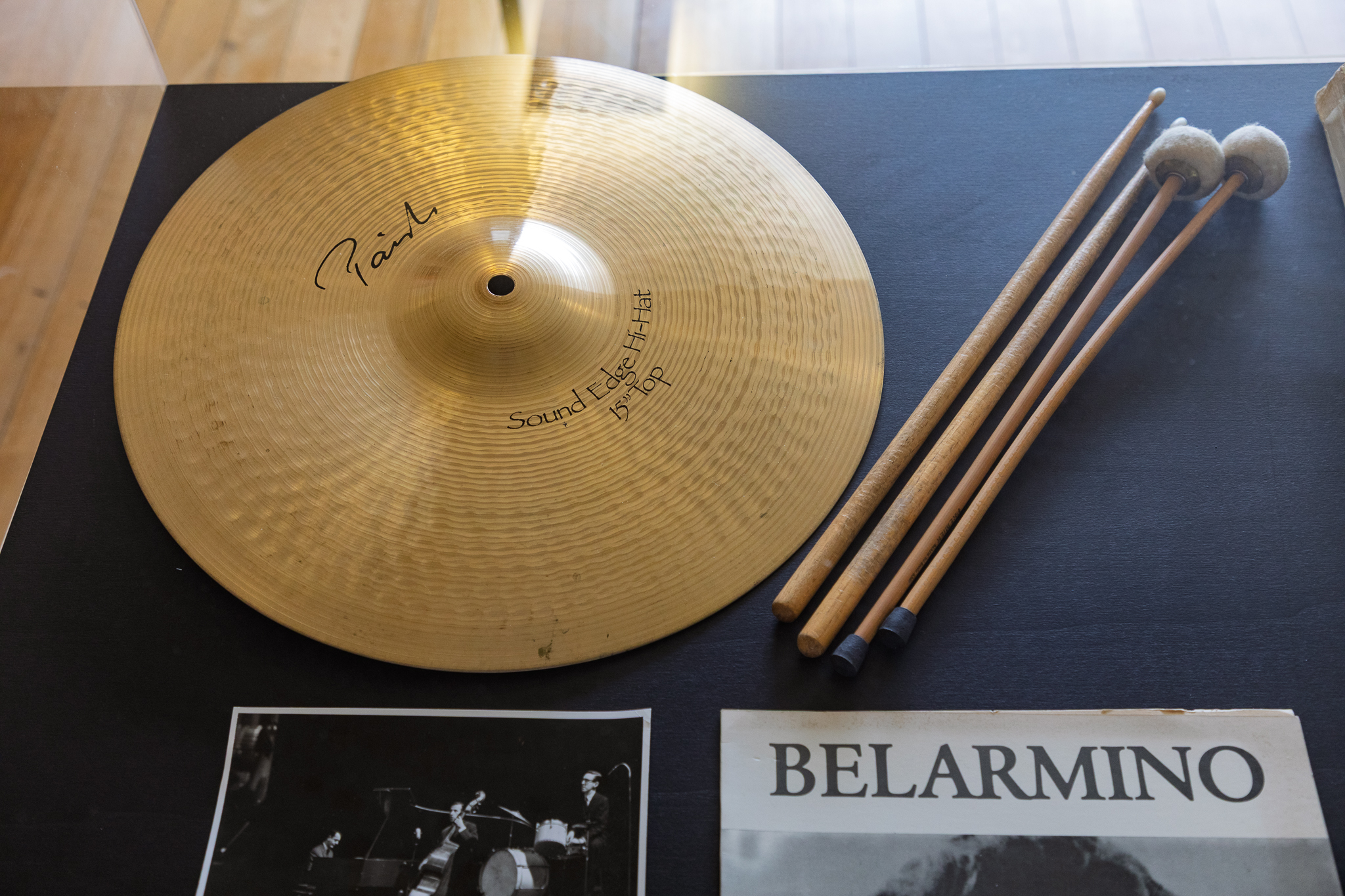
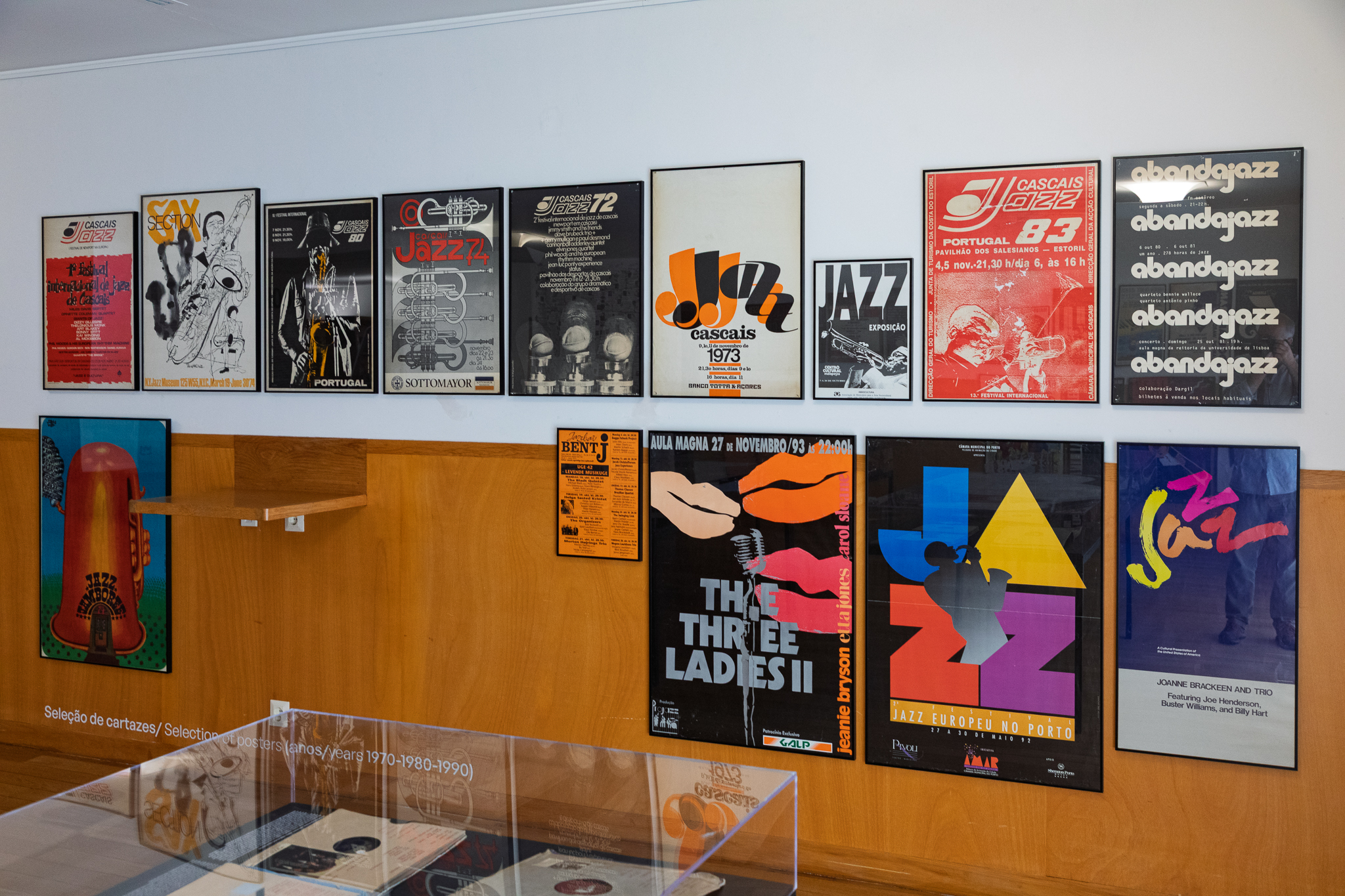
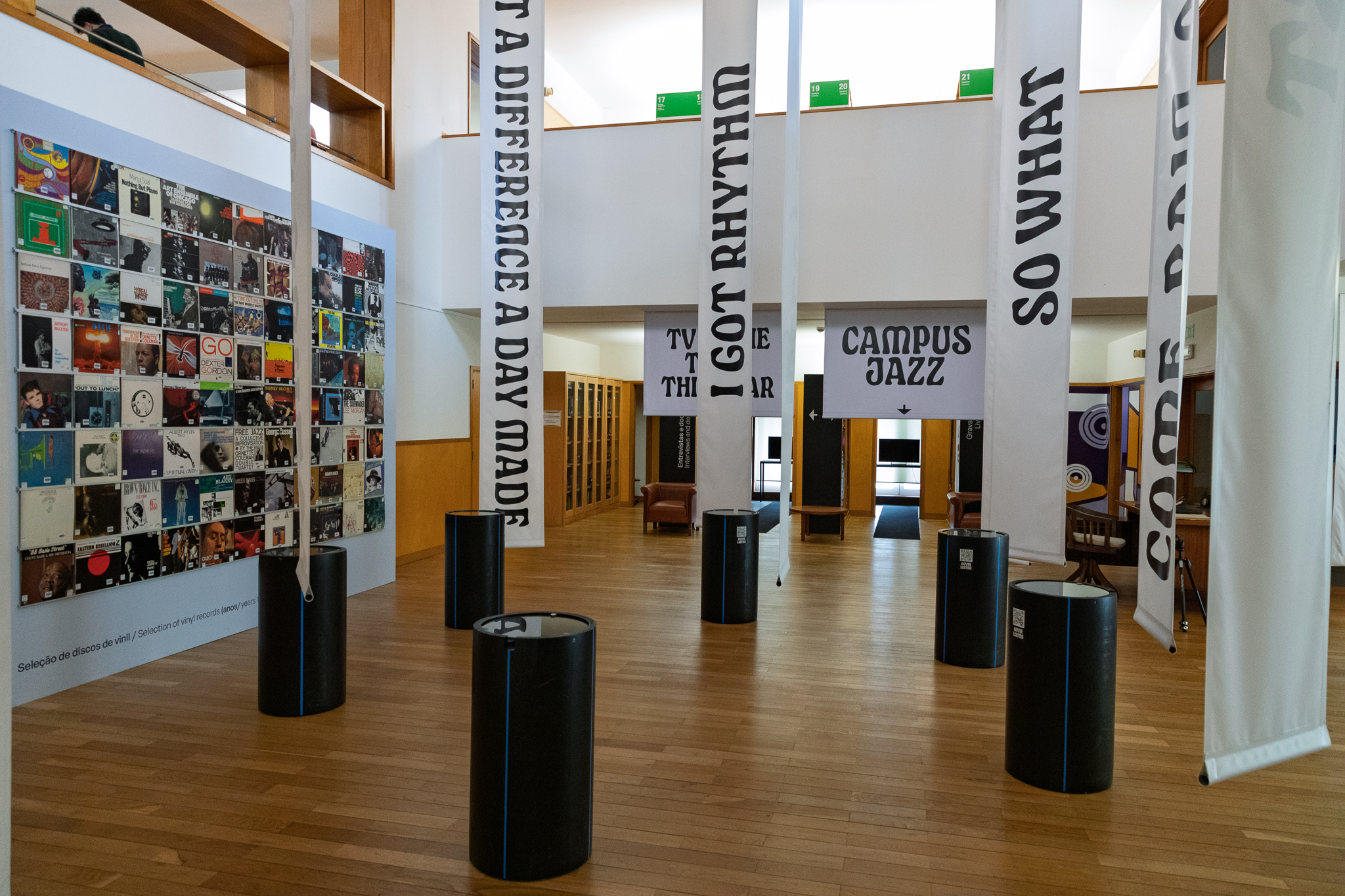
Ivo Martins invited the writer Manuel João Neto and the designer Vera Velez to join him in this task of giving Body and Soul to an exhibition about the CEJ. Together, they chose to lead us through a forest of suspended words, towards a mural of eighty-eight record sleeves emblematic of the history of jazz; to explore the graphic memory of jazz festivals in Portugal, scattered across posters fastened to the walls of the CEJ, with the salt pans in the background; to encounter the first radio through which José Duarte discovered jazz, or the drumsticks used by Manuel Jorge Veloso in Belarmino, Fernando Lopes’s first feature film (1964), for which Manuel Jorge composed and conducted the score, performing it himself on drums.
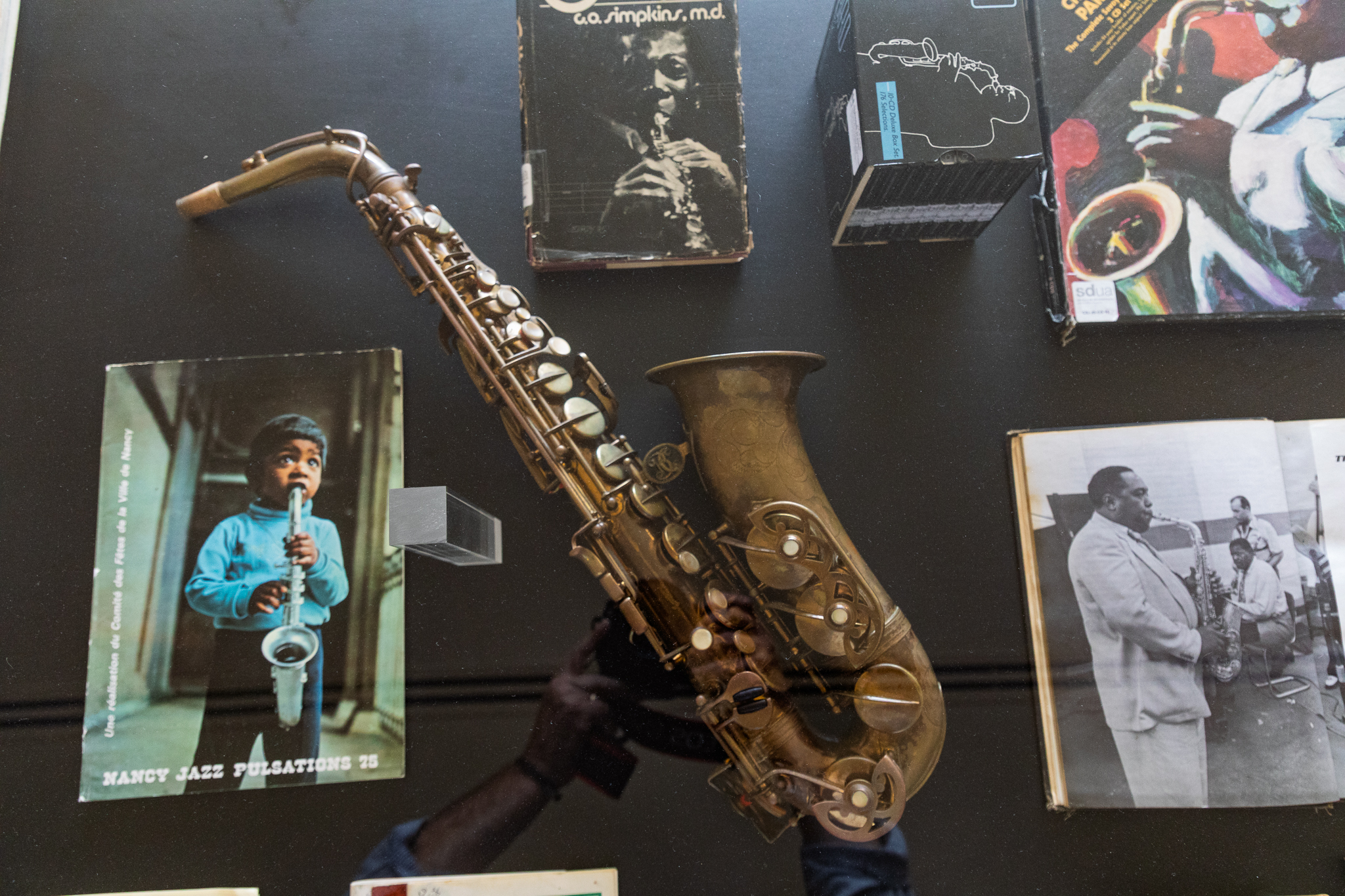
Yet these are only a few of the small and great traces that emerge from Body and Soul. Alongside them are the manuscripts of the radio programmes Cinco Minutos de Jazz and Pão com Manteiga, written in José Duarte’s own hand; the typed scripts of the television programme TVJazz, prepared by Manuel Jorge Veloso; the earliest bulletins of the Clube Universitário de Jazz, founded by Raúl Calado in 1957 and shut down by the politic policing in 1961; and Alan Spennock’s annotated albums, in which each record is enriched by newspaper clip-pings, handwritten notes, and other valuable documents that allow us to glimpse the rituals through which this former rugby player and manager of the British branch of the National Westminster Bank – who settled in Portugal in the 1980s – lived his relationship with jazz.
There are also signs here of the emergence of professional jazz in Portugal, in the form of records, books, and documents that reveal how difficult it was, in politically dark times, to take jazz seriously in this country. Between Spennock’s records, produced in the 1920s, 30s, and 40s, and the first jazz record made in Portugal by Portuguese musicians (Malpertuis, Rão Kyao, 1976), stretches fifty long years of resistance and desire. Body and Soul makes that span of time visible: it reveals it through images, objects, papers, voices, and sounds, restoring to us a history of listening shaped by obsessions and fidelities. We hear José Duarte and Manuel Jorge Veloso’s voices, but we also hear all the others who, in different ways, opened up a space in which jazz could be thought, lived, and shared among us. At heart, that is what this exhibition is about: the way a particular kind of music passes through lives, creates community, and endures, even when only traces seem to remain in an archive shape. Body and Soul reminds us that no archive is ever silent when a passion still beats within it.
Preamble
Ivo Martins, Manuel João Neto
Today, we face a problem of information overload and unbalance with regards to the mechanisms of knowledge assimilation. Our culture of documental abundance reflects a paradoxical relation with the concept of archive, in the sense that it used to signal the intrinsic importance of objects and documents produced in times of archival scarcity. The digital culture we currently live in brought forth an extremely dematerialised field of action that had the effect of amplifying the visibility of music, rendering it ubiquitous. This circumstance promoted a movement of return to and rehabilitation of the legacy of the past with the purpose of reinterpreting the narratives associated to the creation and dissemination of music.
Based on an existent archive, Body and Soul is a construction built from a previous construction (the collection under the care of the Centre for Jazz Studies – University of Aveiro) focused on a peculiar genre of popular music that, in many ways, embodies the spirit of the 20th century. The route defined by this exhibi-tion outlines a sort of sentimental archaeology and sociological map of jazz in its multiple manifestations, wandering freely through the eclecticism of obscure zones and conjectures com-ing from different space and time dynamics. With this objec-tive in mind, we resorted to all materials we had access to – the research, personal experiences, thoughts, and testimonies of individuals who witnessed the making of important moments in the jazz phenomenon –, while at the same time undertaking our own evaluations and creating personal narratives.
In the Centre for Jazz Studies’ collection, time and space are com-pressed into a shapeless historical field that unites thoughts, allusions, causes, consequences, reasons, explanations, argu-ments, inventions, technoscientific innovations, and power games. All of these elements form an irregular and deviating material devoid of a defined trajectory. Themes are left to them-selves, appearing, disappearing, and reappearing again in non-linear and non-chronological fields, thus revealing them-selves, in a sense, to be anti-historical. Because the contents of jazz’s numerous histories are abundant in answers, yet not al-ways understandable or calculated, it is impossible to integrate this immense set of ideas into a coherent and definitive whole, condensed in the various situations presented here.
However, and despite being aware of its limitations, in the synthesis of personal experiences and aesthetic perspectives presented in the exhibition Body and Soul, and now in this book as well – one senses a possible history of the sedimentation of jazz’s iconographic status within the context of 20th century art.
TRANSLATION: MANUEL JOÃO NETO